Tag Archives: manchester united

700 Games Later

Last Saturday, Manchester United beat Wigan 4-0 in a run-of-the-mill Premier League game. Wigan are a small, slightly bizarre club from the north of England. Manchester United also play in the north, but they have more Azerbaijani fans than Wigan do season-ticket holders. This is football, the most monetized sport around, and Manchester United were playing at home. Wigan never had a prayer.

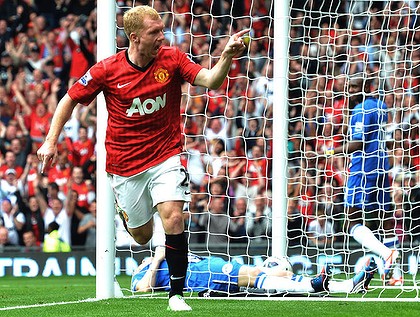
What made this game worth watching, what made it Saturday’s most endearing match – especially in contrast to John Terry’s return to Loftus Road, Anton Ferdinand’s childish non-handshake, and the dismal 0-0 draw that followed – was the shy-looking redhead who opened the scoring (a tap-in) and the almost-40-year-old whose darting runs and incisive dribbling troubled the Wigan defense all afternoon. If you don’t know where I’m going with this – if the names Ryan Giggs and Paul Scholes, or, as they’re commonly referred to, “giggsandscholes” (one syllable), don’t ring a bell – then either you’ve been living in a cave for the last 20 years or you don’t have cable. (Which is worse? I’ll leave that for you to decide.)

Continue reading

Tagged , , , , , , , ,

A Blue Revolution Powered By The Green Stuff

“In soccer, money is destiny,” Brian Phillips wrote in 2011. “And destiny’s not distributed equally.”

At its best, the Premier League is an exhilarating spectacle sustained in part by a moneyed elite that spends millions on superstar players. At its worst, the Premier League feels like a lame excuse for the moneyed elite to play for more money. In the early 1990s, English clubs broke away from the old Football League and formed their own competition designed to realize the commercial potential of a new, streamlined league that would fully embrace live television. Since then, a small band of financially empowered teams has dominated. Sometimes they’re a “Big Four;” sometimes they’re a “Big Three;” once in a while they’re even a “Big Five.” While those clubs vie for major honors, the rest of the Premier League invents and then competes in a series of phony battles, the most notable of which is “The Battle To Avoid The Drop” and the most banal “The Battle To Finish In The Top Ten If, By April, We’re Too Good For The Drop But Not Good Enough For Europe.”

Occasionally, it’s possible for traditionally weak teams to break into the top tier; however, such maneuvers require the type of money that Chelsea, traditionally a promising but never truly successful club, has enjoyed since 2003, when Russian billionaire and celebrity yacht-owner Roman Abramovich decided, virtually on a whim, that he rather liked Stamford Bridge. After a couple of seasons of steady investment, self-proclaimed “Special One” Jose Mourinho secured Abramovich’s team the Premier League title. And last year, after numerous failed attempts, Chelsea became the first London club to win the Champions League, or European Cup — as it was known before a certain fascination with the green stuff necessitated a rebranding.

Continue reading

Tagged , , , , , , , , , ,

Fallen Star: The Decline of Federico Macheda

Federico Macheda took just 25 minutes to become a legend. His goal against Aston Villa in April 2009 was the cathartic explosion that propelled Manchester United to their 18th league title, equaling Liverpool’s long-standing record and answering what now seems a very ill advised banner. This being Old Trafford, Sir Alex Ferguson and Manchester United, the goal came in stoppage time, completed a comeback and obscured what was otherwise a worryingly poor performance.

Conventional wisdom holds that Macheda’s strike – which, if you’re like me, you watch on YouTube about 25 times a day – confirmed that United’s youth system had life after Giggs and Scholes and that Ferguson wasn’t turning into a big-spending, modern football capitalist after all. Although this view is prominent on Manchester United forums, it is more than slightly dubious: Federico Macheda is not in fact a Manchester native. (Yeah, I know: I was fooled, too).

Continue reading

Tagged , , , , , , , , ,

Goodbye, Ji-Sung Park

Ji-Sung Park isn’t a gifted footballer, but not for want of trying. Manchester United’s first Korean player is also Manchester United’s most endearing try-hard, their most blatant commercial maneuver and their most bizarre success story. When Rafa Benitez bought Dirk Kuyt and then immediately shifted him to an unnatural wing position, he probably had Ji-Sung Park in mind, which – considering that United and Liverpool are about as friendly as Olof Mellberg at the full moon – says a lot, and not just about capitalism.
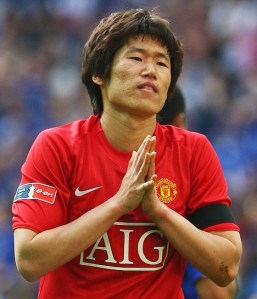
As you may have heard, the Ji-Sung Park Old Trafford fantasy, packaged and sold to millions of hopeful Seoul teenagers, is about to come screeching back to earth in a burst of super-charged dream-busting so powerful that it will probably blow the roof off Loftus Road, a quaint stadium in the middle of a quiet London neighborhood terrifically unsuited for this type of cosmic event. For legions of gullible Korean teenagers, Park’s transfer to QPR will probably be heartbreaking, maybe life-changing, and certainly soul-destroying. United scarves will burn tonight.

For a man whose right to play football for Manchester United has been questioned constantly by a cohort of cynical newspapermen convinced that he was bought more for his marketability than for his playing ability, seven years at arguably England’s most successful club, but indisputably England’s most successful club over those seven years, represents a fair old career. Compared to the career of United’s other notable “commercial” recruit, Chinese striker Dong Fangzhou, Park’s tenure looks even more impressive.

Park broke into the United first team through sheer persistence. So what if he couldn’t keep up with Nani’s juggling, or was blinded by Ronaldo’s stepovers? No one expected Park to be skillful. Occasionally, he’d score a great goal, and, as one, the entire Stretford End would gasp, gawk and stare suspiciously: He’s not supposed to do that, is he? Park was always so predictable in his mundane effectiveness that every time he did something extraordinary, fans’ initial excitement dissipated in confusion. Watching Park dribble past three players wasn’t just surprising, — it felt wrong, almost as if this particular professional footballer, the captain of his country and a Champions League winner, couldn’t copy his talented peers without breaking some law of footballing physics.

Continue reading

Tagged , , , ,

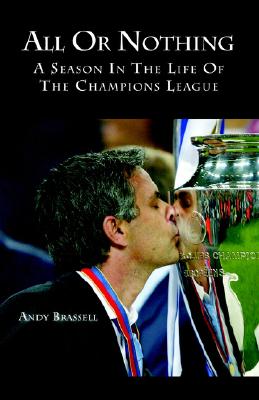
INFTH Book Review: All Or Nothing

At football’s European epicenter lies the world’s premier annual sporting competition. The Champions League shapes the
ambitions of clubs across the continent; all of them dreaming of the same ungainly, two-handled trophy. All or Nothing is the story of that tournament. The story of the teams, fans and players that make-up modern football’s most defining edifice.

Andy Brassell sets out to understand the Champions League’s transcendent influence on European club football, to examine how the tournament affects competitors big, small and in between. Unfortunately, Brassell’s account of one “season in the life of the Champions League” fails to compel. It’s not fresh, it’s not new and it’s not exciting. Moreover, only eight years after publication, it’s hopelessly out of date.

Continue reading

Tagged , , , , , ,

Retrospective: The Week That Destroyed A Season

When the bards sing of deeds gone by or poets write in remembrance, memory is always airbrushed. As an eager, fresh-faced boy desperate to fill my mind’s expanse of blankness, I noticed, interested, the holes in Manchester United’s rich history. The period for instance that some call the 1970s, is one afforded only a cursory sentence or two in all the unofficial accounts I read, seemingly, football hadn’t happened between around the time George Best lifted the European Cup and the day Ron Atkinson cleaned out his office.

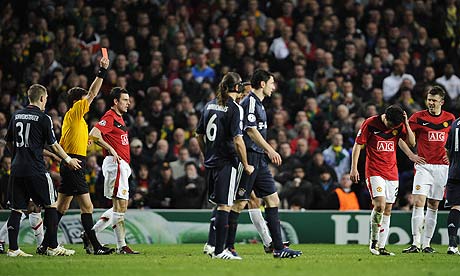
What with decades disappearing, to misplace a week might seem a trifling matter, but here I seek to preserve one of the worst. Observed through the lens of glories since, the first seven days of April 2010 lose poignancy – victory’s narcotic effect blurring our understanding of what it means to lose. Pain, all too happily sedated.

The weather was nice, early Spring temperatures in Germany complementing early spring moods in Manchester – moods dictated by a script long since memorized.

Adjustment had been an overarching theme that year. The departures of Cristiano Ronaldo and Carlos Tevez kicked off a period of change. In came Antonio Valencia and Michael Owen, as a goalscoring burden of titanic proportions shifted onto the shoulders of Wayne Rooney.

Read more at Man Utd 24.

Tagged , , , , , , , ,

Berbatov Is Forever Consigned To Under Appreciation

According to legend, Berbatov’s Mancunian adventure started unconventionally – under a blanket in the back of Ferguson’s car, as he was speedily whisked away from the admiring hands of Manchester City. 

In years hence though, all has been predictable. The daily abuse, the cheap cracks and descriptors starting with “l” are functions of a society inherently against footballers in the mold of Dimitar Berbatov.

Despite standing at six foot two, the Bulgarian hardly intimidates. His stature is slightly offset by a permanent slump of the shoulders and furrowing of the brow, two characteristics most manifest in times of struggle. And for Berbatov, struggle is never far away.

Quite apart from the expectation automatically applied to all Manchester United front players – especially ones that cost in excess of thirty million pounds – Berbatov is the subject of a special kind of scrutiny. There is an unshakable feeling among commentators and journalists alike that his case deserves questioning of an intensity normally only applied to England managers, brothel frequenters and John Terry.

To see Berbatov play is for many to have triggered a sort of righteous indignation, anger at an individual so distinctly different from the Premier League’s proletariat masses. The haughty exterior, hair band (until it was shorn a couple seasons ago) and deceptive, almost arrogant movement, all made great copy throughout each season of supposed under performance.

Continue reading

Tagged , , , , , ,

Moment #2: Van Der Sar’s Moscow Heroics

This one is by me, The Chairman; David Yaffe-Bellany, editor of In For The Hat Trick.

The rain glistened off his head. Sparkling like the cosmos, the gloriously bald Nicolas Anelka took his first tentative steps. In the slightly blurred background, Van Der Sar beat his hands together looking, presumably, to inspire a last bout of energy. Twenty fellows anxiously waited, millions more consumed excitedly, all were transfixed by the action unfolding. 

I had always been a sucker for penalty shoot-outs. The sheer, almost manufactured drama inherent in these most ultimate of deciders is an addictive drug – pure, unadulterated adrenaline.

But here something was different. The grown men covering their eyes with scarves were my men, the sweat soaked victims of football’s fickle executioner were my players.  Everything was distinctly more personal.

A neglected, fast cooling box of pizza lay discarded in the corner, beside it, an untouched pitcher of water. ESPN’s transmission lit up a rather morbid setting, even Tommy Smyth’s inept analysis was met with no complaint. Laying prone on the couch was a rather unattractive lifeform, its steely gaze fixed on the television – as the nostalgic elderly might have it, a quintessential twenty-first century human.

As Anelka strode nervously to the penalty spot, the slumping figure straightened to attention. Expectation began to prevail, hope usurped negativity. Dressed in marvelous green, Van Der Sar looked the part. His arms waved menacingly, daring Anelka to score, daring him to deny United a third sojourn into European nirvana.

Continue reading

Tagged , , , , , , ,

The Premier League Continues To Excel At Its Own Kind Of Magic

It wasn’t tiki-taka. Geometric precision may have been lacking, but the Premier League’s latest serving beats the rest in spice. As tactical and ideological trends emanating from Catalonia continue to dictate the musings of football’s intelligentsia, the English game remains resolute and stubborn.

Never mind the intricate little noises coming from Spain and the revolutionaries in Italy, here we refuse to conform. Here penalties are better in the stands, strikers when they’re missing and artisans when flat on their faces.

Here the populace care not for immaculate technicians. It is in its parochialism that the Premier League has once again usurped the rest, claimed lost ground in a perpetual battle for perfection. The decline of an overwhelmingly cosmopolitan outpost, coupled with an influx of English talent to the country’s most recent European adventurers has seen the league regain a superiority once considered inherent.

The difference is in the drama. As Tony Evans succinctly put it on Twitter, “football is more poetry than maths.” In search of poetic meaning, hunters had not to look far, the story of Fernando Torres might as well have been penned by Thespis or Aeschylus, such was the distinctness of its tragedy; redemption wiped away by a moment of the utmost horror. Someone high up there clearly owns a Manchester United scarf.

Continue reading

Tagged , , , , , , ,