Tag Archives: ferguson

Ninety Minutes From The Sack

Last week, Manchester United unveiled a statue of legendary manager Sir Alex Ferguson. Bronze-Fergie’s hands are di matteofolded across bronze-Fergie’s chest, and while bronze-Fergie seems to be missing flesh-Fergie’s legendary watch, the sculptor looks to have done a pretty accurate job. Ferguson has coached United for more than 25 years. In that time, ten Liverpool managers have come and gone. Among the top English clubs (sorry, Everton), only Arsenal has a coach whose longevity rivals Sir Alex’s, and even he trails Fergie by a decade.

Ferguson is the last survivor of a dying era. Last month, Mark Hughes of Queens Park Rangers and Roberto Di Matteo of Chelsea were both fired after less than a year at their respective clubs. Hughes’ sacking came after a disappointing start to QPR’s season, but Chelsea won the Champions League earlier this year, and, at the time of Di Matteo’s dismissal, was only four points off the top of the Premier League. The team was also playing attractive football, which, for Chelsea – a club whose blunt, bullying, borderline-racist players[1] have been intimidating the West Broms of this world for about seven years – is not so much highly unusual as highly suspicious.

At least 90 percent of Di Matteo’s downfall had more to do with Chelsea owner Roman Abramovich and his bizarre, illogical management than it did with Di Matteo himself. Abramovich is an entertainingly shady Russian billionaire whose penchant for firing managers who probably don’t deserve to be fired has turned him into a bit of a cartoon enemy. There are probably lots of kind, humble Chelsea supporters who are deeply ashamed of their inability to hate Abramovich, and who spend at least a couple of minutes each day pondering this moral failure[2]. Without Ambramovich, Chelsea wouldn’t fire managers on a regular basis: his bizarre egomania forces the sackings, and his billions fund the big severance checks that departing managers take with them as a sort of consolation prize[3]. But remove Ambramovich from the equation, and Chelsea is a mid-table team. The Stamford Bridge faithful is obligated to love him.
Continue reading

Tagged , , , , , , , ,

700 Games Later

Last Saturday, Manchester United beat Wigan 4-0 in a run-of-the-mill Premier League game. Wigan are a small, slightly bizarre club from the north of England. Manchester United also play in the north, but they have more Azerbaijani fans than Wigan do season-ticket holders. This is football, the most monetized sport around, and Manchester United were playing at home. Wigan never had a prayer.

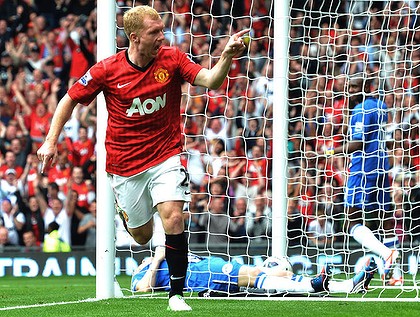
What made this game worth watching, what made it Saturday’s most endearing match – especially in contrast to John Terry’s return to Loftus Road, Anton Ferdinand’s childish non-handshake, and the dismal 0-0 draw that followed – was the shy-looking redhead who opened the scoring (a tap-in) and the almost-40-year-old whose darting runs and incisive dribbling troubled the Wigan defense all afternoon. If you don’t know where I’m going with this – if the names Ryan Giggs and Paul Scholes, or, as they’re commonly referred to, “giggsandscholes” (one syllable), don’t ring a bell – then either you’ve been living in a cave for the last 20 years or you don’t have cable. (Which is worse? I’ll leave that for you to decide.)

Continue reading

Tagged , , , , , , , ,

Fallen Star: The Decline of Federico Macheda

Federico Macheda took just 25 minutes to become a legend. His goal against Aston Villa in April 2009 was the cathartic explosion that propelled Manchester United to their 18th league title, equaling Liverpool’s long-standing record and answering what now seems a very ill advised banner. This being Old Trafford, Sir Alex Ferguson and Manchester United, the goal came in stoppage time, completed a comeback and obscured what was otherwise a worryingly poor performance.

Conventional wisdom holds that Macheda’s strike – which, if you’re like me, you watch on YouTube about 25 times a day – confirmed that United’s youth system had life after Giggs and Scholes and that Ferguson wasn’t turning into a big-spending, modern football capitalist after all. Although this view is prominent on Manchester United forums, it is more than slightly dubious: Federico Macheda is not in fact a Manchester native. (Yeah, I know: I was fooled, too).

Continue reading

Tagged , , , , , , , , ,

Balotelli Is Starting To Define The New City

While failed bathroom experimentation may have condemned his pyrotechnic career to the realms of lazy humor, Mario Balotelli’s footballing talent has finally found the greenery most conducive to its belated blossoming.

The frown so intrinsically linked with his controversial endeavor failed to disappear, but in this culmination of careful improvement Balotelli showed that he’s more than just a troublesome ornament.

After years of almost constant indignation, it was easy to sympathize with the forward’s celebratory message. “Why always me?” read his undershirt – revealed just after the first of six Manchester City goals.

Continue reading

Tagged , , , , , , ,

Retrospective: The Week That Destroyed A Season

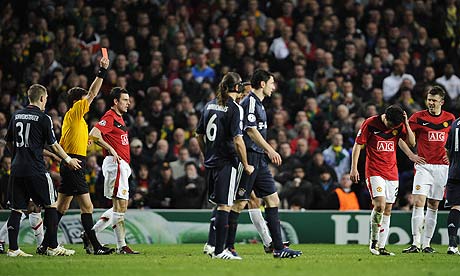
When the bards sing of deeds gone by or poets write in remembrance, memory is always airbrushed. As an eager, fresh-faced boy desperate to fill my mind’s expanse of blankness, I noticed, interested, the holes in Manchester United’s rich history. The period for instance that some call the 1970s, is one afforded only a cursory sentence or two in all the unofficial accounts I read, seemingly, football hadn’t happened between around the time George Best lifted the European Cup and the day Ron Atkinson cleaned out his office.

What with decades disappearing, to misplace a week might seem a trifling matter, but here I seek to preserve one of the worst. Observed through the lens of glories since, the first seven days of April 2010 lose poignancy – victory’s narcotic effect blurring our understanding of what it means to lose. Pain, all too happily sedated.

The weather was nice, early Spring temperatures in Germany complementing early spring moods in Manchester – moods dictated by a script long since memorized.

Adjustment had been an overarching theme that year. The departures of Cristiano Ronaldo and Carlos Tevez kicked off a period of change. In came Antonio Valencia and Michael Owen, as a goalscoring burden of titanic proportions shifted onto the shoulders of Wayne Rooney.

Read more at Man Utd 24.

Tagged , , , , , , , ,

Berbatov Is Forever Consigned To Under Appreciation

According to legend, Berbatov’s Mancunian adventure started unconventionally – under a blanket in the back of Ferguson’s car, as he was speedily whisked away from the admiring hands of Manchester City. 

In years hence though, all has been predictable. The daily abuse, the cheap cracks and descriptors starting with “l” are functions of a society inherently against footballers in the mold of Dimitar Berbatov.

Despite standing at six foot two, the Bulgarian hardly intimidates. His stature is slightly offset by a permanent slump of the shoulders and furrowing of the brow, two characteristics most manifest in times of struggle. And for Berbatov, struggle is never far away.

Quite apart from the expectation automatically applied to all Manchester United front players – especially ones that cost in excess of thirty million pounds – Berbatov is the subject of a special kind of scrutiny. There is an unshakable feeling among commentators and journalists alike that his case deserves questioning of an intensity normally only applied to England managers, brothel frequenters and John Terry.

To see Berbatov play is for many to have triggered a sort of righteous indignation, anger at an individual so distinctly different from the Premier League’s proletariat masses. The haughty exterior, hair band (until it was shorn a couple seasons ago) and deceptive, almost arrogant movement, all made great copy throughout each season of supposed under performance.

Continue reading

Tagged , , , , , ,