You Should Watch The Africa Cup of Nations

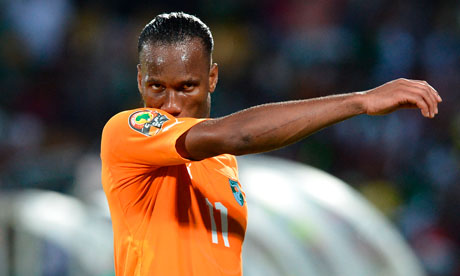
The Africa Cup of Nations is profoundly confusing. Take, for instance, the star-studded Ivory Coast team: it entered Didier Drogba, Ivory Coast captainthe last few ACONs as the heavy favorite, only to lose dramatically to feel-good teams like Zambia, which won the 2012 ACON in Gabon, the country where several of Zambia’s greatest players died in a tragic early-‘90s airplane “accident” that may or may not have been orchestrated by the Gabonese military.
Typically, football fans refer to the ACON – which used to be held during World Cup and European Championship years, but which is adjusting its rotation in an almost certainly futile effort to garner more prestige/viewers/Jonathan Wilson columns – as a “festival of football,” a term that’s rooted in the utterly erroneous, semi-racist perception of Africa as a place where tribe members chant exotic chants and bang exotic drums and just generally have a good time. (For reasons that don’t make very much sense, the whole concept of this, like, giant football party! gained popularity during the South African World Cup.) Of course, African football is nothing like that. After the first wave of Cameroon-got-to-the-quarters-and-Pele-thinks-Africa-will-win-a-World-Cup hysteria passed, Africans spent more than a decade dealing with corruption and white elephant stadiums and teenage stars whose “burgeoning talents” (or whatever) turned out to be figments of some gossip website’s imagination.
Continue reading

Tagged , , , , , , , , ,

This Is Leeds

Last week, Leeds United signed Habib Habibou, best known for a YouTube video in which he manhandles a duck. Just thought I’d share that.

Everyone Hates Chelsea

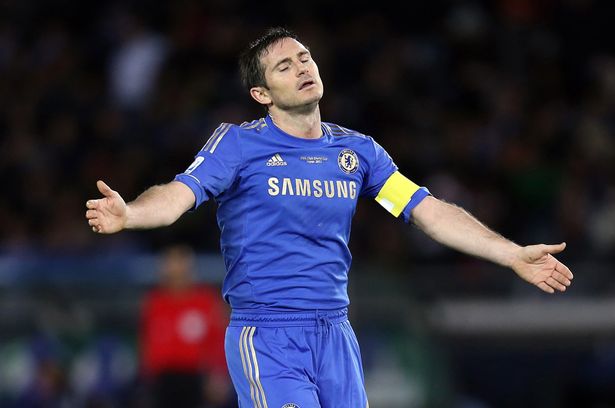
Jose Mourinho’s Chelsea won its first Premier League title in 2005 and its second in 2006. In 2007, Mourinho lampdsresigned after falling out with owner Roman Abramovich[1]. Of the players involved in the two title successes, only Ashley Cole, Frank Lampard, John Terry, and Petr Cech still play for the club, and Lampard is almost certain to leave this summer. The Mourinho-era Chelsea was a ruthless winning machine; today’s Chelsea recently lost to QPR – Harry Redknapp’s latest project, bottom of the Premier League — at Stamford Bridge. These days, Rafa Benitez – who was once a potent symbol of the Chelsea’s Got No History movement, which, yes, was as stupid as it sounds – sits in the Stamford Bridge dugout. The Chelsea fans hate him and express their hatred in chants and songs whose lyrics are unprintable, even on the Internet.

During Chelsea’s rise to championship contention, the traditional powerhouses of English football – Manchester United and Liverpool — were too busy recovering from the financial train wreck that is American ownership to launch serious title bids. Manchester United’s management is renowned for its efficiency, professionalism, and general excellence in the field of everything, but in the early 2000s, it made a series of uncharacteristically thoughtless administrative decisions that opened the door to outside investment — and the Glazers were never going to knock. Liverpool was fading, thanks largely to the idiocy of Tom Hicks and George Gillette, businessmen who epitomize everything that’s bad about sports, business and the United States of America.

Continue reading

The Very Best Of Friends

It’s La Liga’s winter vacation, and Lionel Messi hasn’t scored a goal in more than two weeks. Which, after Messi’sbarca real era-defining, award-winning, 91-goal 2012, comes as a bit of a relief. He’s good, but enough already. Messi’s Barcelona is undefeated in the league, and with two Champions League titles, four La Liga championships and the odd Official FIFA Triumph[1] under its belt, the team is arguably (because these things are always arguable) the greatest of modern times.

At this point, the ins and outs of Barcelona’s recent history are common knowledge: how homegrown players like Xavi, Iniesta, Fabregas, Puyol, Valdes, Pedro, Busquets and Messi gelled in Barca’s legendary academy; how Zlatan Ibrahimovich, one of the most talented players of his generation, simply couldn’t adjust to Barca’s selfless passing style and eventually fell out with Pep Guardiola (supposedly the nicest man in football, so the joke was definitely on Zlatan); how Spain, a perennial underachiever for most of its history, suddenly became world and European champions, thanks mostly to the same homegrown players (minus Messi) who boarded together as kids. It’s impossible to understand the last five years of football history without first understanding Barcelona. Since 2008, virtually everything that’s happened on the European football scene has happened because of Guardiola-era Barca.

Continue reading

Tagged , , , , , , , , , , , , ,

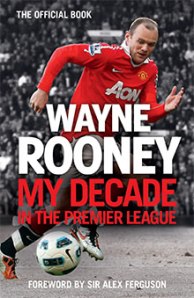
Keep Your Day Job: Wayne Rooney Writes Another Terrible Book

At 27, Wayne Rooney is already a bona fide Manchester United legend. His goals are watched and analyzed around rooney bookthe world, his jerseys sell in ridiculous numbers, and his statistics speak for themselves. United recently unveiled a statue of Sir Alex Ferguson, and, if Rooney plays his cards right, he could be next in line for the bronze treatment.

Between games, or perhaps during summer vacations, Rooney has also managed to publish two autobiographies. Neither is very good.

Rooney’s new memoir, My Decade in the Premier League, picks up where Rooney: My Story left off. My Story was released about ten minutes after England’s penalty-shootout loss to Portugal in the quarterfinals of the 2006 World Cup. Red-carded midway through that game’s second half, Rooney had just become a national pariah, and, once he’d reached pariah-status – well, a book was inevitable.

The debate over whether the offense that earned Rooney that red card – “stamping” on Portuguese defender Ricardo Carvahlio – was indeed an intentional act of violence, as the ref believed, or merely a misunderstanding traceable to Rooney’s reputation for impulsive thuggery isn’t nearly as central to this latest autobiography. As Sir Alex Ferguson reminds us in the forward, My Decade is about a mature, level-headed Rooney, a Rooney for whom impulsive thuggery is a thing of the past.

Continue reading

Tagged , , , , ,

Ninety Minutes From The Sack

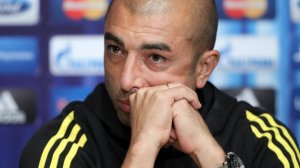
Last week, Manchester United unveiled a statue of legendary manager Sir Alex Ferguson. Bronze-Fergie’s hands are di matteofolded across bronze-Fergie’s chest, and while bronze-Fergie seems to be missing flesh-Fergie’s legendary watch, the sculptor looks to have done a pretty accurate job. Ferguson has coached United for more than 25 years. In that time, ten Liverpool managers have come and gone. Among the top English clubs (sorry, Everton), only Arsenal has a coach whose longevity rivals Sir Alex’s, and even he trails Fergie by a decade.

Ferguson is the last survivor of a dying era. Last month, Mark Hughes of Queens Park Rangers and Roberto Di Matteo of Chelsea were both fired after less than a year at their respective clubs. Hughes’ sacking came after a disappointing start to QPR’s season, but Chelsea won the Champions League earlier this year, and, at the time of Di Matteo’s dismissal, was only four points off the top of the Premier League. The team was also playing attractive football, which, for Chelsea – a club whose blunt, bullying, borderline-racist players[1] have been intimidating the West Broms of this world for about seven years – is not so much highly unusual as highly suspicious.

At least 90 percent of Di Matteo’s downfall had more to do with Chelsea owner Roman Abramovich and his bizarre, illogical management than it did with Di Matteo himself. Abramovich is an entertainingly shady Russian billionaire whose penchant for firing managers who probably don’t deserve to be fired has turned him into a bit of a cartoon enemy. There are probably lots of kind, humble Chelsea supporters who are deeply ashamed of their inability to hate Abramovich, and who spend at least a couple of minutes each day pondering this moral failure[2]. Without Ambramovich, Chelsea wouldn’t fire managers on a regular basis: his bizarre egomania forces the sackings, and his billions fund the big severance checks that departing managers take with them as a sort of consolation prize[3]. But remove Ambramovich from the equation, and Chelsea is a mid-table team. The Stamford Bridge faithful is obligated to love him.

Continue reading

Tagged , , , , , , , ,

The Biggest Mess in Major League Soccer

Major League Soccer’s 19-team league season ends in a one-month, winner-takes-all playoff competition designed to generate a crazy amount of fun in a short period of time, but not necessarily to hand the cup to the team that, by any European standard, is truly the best in the land. In 2010, the un-fancied Colorado Rapids rose from sixth seed to beat FC Dallas, the most successful regular-season team, in the MLS Cup final. Real Salt Lake had done something similar the year before, and, even further back, teams like the New England Revolution had prided themselves on season-defying mid-October bursts that, almost inevitably, ended in cup-final appearances

These stories don’t illustrate the beauty of underdog successes. Contrary to popular belief, underdog successes are never “good for the game,” unless you think that stripmining the game’s biggest stars from the game’s biggest showcase is positive and exciting and worth dancing in front of the TV about. Rather, these stories reveal the inherent randomness of the MLS playoffs: Since the competition admits nine of its 19 teams into the post-season, there’s always a chance that one of the lesser lights will put together a run and knock out a more established force.

The 2012 MLS Cup final is still about a week and a half away, but one team we know won’t be playing in it is the San Jose Earthquakes, whose league-topping regular-season performances counted for nothing in the Western Conference semi-finals. But arguably the most shocking casualty of this year’s playoffs is the New York Red Bulls – not shocking in the sense that no one expected New York to be eliminated, but shocking in the holy-shit-they-really-screwed-up sense, where you’ve got your jaw hanging open even before the final whistle sounds, and then two days and a lot of internal therapy later your jaw’s still hanging open (and, at this point, people are starting to stare) because it was just that mesmerizingly gruesome.

Continue reading

Tagged , , , , , , , , ,

Chris Wondolowski and the Beauty of Records

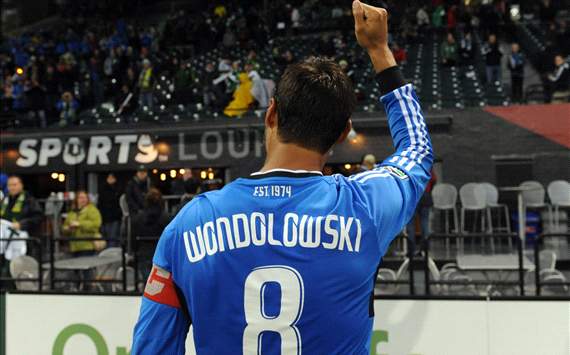
Chris Wondolowski is celebrating right before my eyes, which isn’t much of a surprise, because he’s celebrating right before everyone else’s, too. He’s grinning in that half-serial-killer half-kid-in-a-candy-shop way that’s endearing but also kind of terrifying. In a few days, he’ll probably be crowned the best – or, because this is America, “the most valuable” – MLS player of the 2012 season. In the unlikely event that someone else wins, San Jose fans will get very upset, and a massive Internet argument, replete with blog posts, newspaper articles, Twitter feuds, and message board profanity, will ensue. Wondo – who plays foil to strike partner and probable-Antichrist Steven Lenhart[1], and who also scores goals[2] and smiles and always stays on his feet, will say he doesn’t care, that there’s no “I” in team, but really he’ll be smarting, because these things matter more than they should.

For those of you who don’t already know, Wondolowski is, alongside the MLS Disciplinary Committee, the most talked-about story of MLS 2012. His team, the San Jose Earthquakes, won this year’s Supporter’s Shield[3] in buccaneering, come-from-behind style. For his part, Wondo has spent the year chasing the record for most goals scored in a single MLS season.

Continue reading

Tagged , , , , , , , , , , ,

AVB and Avoiding Disaster

For some reason, Spurs are interesting [1] this year. That’s not to say that they weren’t interesting last year – or the year before, or during their glory days in the mid-60s – but just that there’s something weirdly attractive about the way their season is shaping up. Perhaps it’s the wonderfully Icelandic-sounding Icelandic international Gylfi Sigurdsson. Or perhaps it’s the unquestionable appeal of Andre Villas-Boas, the fist-pumping Mourinho protégé who steered Porto to a treble two years ago, then landed the Chelsea job, then fell back to earth five months later, haunted by John Terry’s menacing laughter. Of course, the real reason is probably a lot more mundane – probably something to do with Jermain Defoe’s goal-scoring streak.

Spurs aren’t the best team in the league, and they almost certainly won’t finish in the top four this season. Last summer, their best player, Luka Modric, sacrificed his status as one of the biggest stars in the Premier League for the chance to become one of the smallest stars in Real Madrid’s midfield. Harry Redknapp – part-time football manager, part-time Nintendo Wii poster boy, full-time hilarious-courtroom-quip producer – was sacked in May after putting Tottenham within a German-team’s-winning-a-penalty-shootout of Champions League qualification. But that’s just kind of how Spurs roll. They’re only stable when their backs are against the wall, only happy when they’re on the wrong end of a transfer tug of war, or when Daniel Levy gets to spend deadline day toying with Dimitar Berbatov’s footballing future. Spurs didn’t bother to wait for the advent of the Premier League before executing their slow drift from title contender to top four pretender. Their slide started the moment Bill Nicholson quit.[2]

Continue reading

Tagged , , , , , , , , , , ,